• BUYING AN ANTHEM HOME? Click here to search for it here!
  • Home
  • Blog Page
  • Have a Question?

All About Anthem, Arizona

Learn About Anthem Arizona Community

  • Anthem Schools
  • Anthem Neighborhoods
    • Parkside – East and West
    • Country Club
    • The Landings
    • The Villages
    • The Paseos
  • Anthem Floor Plans
    • Anthem Country Club Floor Plans
    • Anthem Parkside Floor Plans
  • Anthem Community Park
  • 🎉 Welcome Home to Anthem

Silicon Desert: How TSMC Is Quietly Transforming North Phoenix

At first glance, the land north of Phoenix still looks like what it has been for decades: pale dirt, creosote bushes, distant mountains wavering in the heat. But drive far enough toward the city’s northern edge—past the last big-box stores and the master-planned communities that taper into open desert—and you hit something that feels out of place. Towering steel structures. Cranes frozen mid-air. A project so large it has its own gravity. This is where the future is being poured, slab by slab.

The expansion of TSMC’s semiconductor campus in Phoenix’s North Gateway has become one of the most consequential industrial investments in modern Arizona history. It’s also one of the least fully understood by the people who live closest to it. Most residents know the headline numbers—tens of billions in investment, thousands of jobs, national security implications. Fewer have grappled with what this actually means on the ground: for housing, infrastructure, and daily life across the North Valley.


A Desert Bet With Global Stakes

https://www.azcentral.com/gcdn/presto/2022/12/06/PPHX/fe1e1ff3-065d-4994-affd-778c7947faf7-TSMC_Arizona_-_December_2022.jpg?crop=900%2C900%2Cx400%2Cy0
https://images.openai.com/static-rsc-3/KE_PGXv7Ok68Udv-y9MngxPtBzVn_6WC_ixvWgPvgHksDxwupLrLrGYZbUetZwLUO5EaML0R6rMcWCLHwAzjV-nNSWOaqYgChPhjUwV632M?purpose=fullsize&v=1

This isn’t just a factory story. It’s a city story—still being written.

When TSMC announced its first Arizona fabrication plant in 2020, the move landed like a geopolitical thunderclap. Semiconductors—the invisible components powering everything from vehicles to medical devices—had become the world’s most fragile supply chain. The U.S. wanted domestic production. Taiwan wanted diversification. Arizona emerged as the unlikely middle ground.

According to The Wall Street Journal and Bloomberg, federal incentives from the CHIPS and Science Act later accelerated the project, pushing planned investment beyond $65 billion.
External references:

  • https://www.wsj.com
  • https://www.bloomberg.com

National coverage frames the move around geopolitics. Locally, the impact is more tangible. Construction traffic. Shift changes. Desert parcels once written off as “someday land” now discussed in terms of logistics hubs, supplier campuses, and housing tracts.

The North Valley is no longer speculative. It’s operational.


Why North Phoenix, and Why Now?

https://images.openai.com/static-rsc-3/pQGWapQ16Sf_ABlklIez8YaKvWoL1gpWh614E608SouxvWYlGII4cssgHsJVSZfBrK_Ohps3kR_VSNHKgl6qQmKLmSGcMFpO9wfy0mepvsM?purpose=fullsize&v=1
https://images.openai.com/static-rsc-3/uetEepyVefq4DeJJwYh56OcY_pTThKLhdBA1X7VAqb-_6y3LVboU6bDvM_XEsGFpLUgyLjD2sq75Q-2Cd7Gm5g80870abnZzuBdH3s18-RU?purpose=fullsize&v=1

The North Gateway area didn’t land this project by accident. It offered what few metro regions still can: large contiguous land, expandable power infrastructure, and direct access to I-17 without immediate residential displacement.

That buffer is shrinking.

Economic development officials often describe TSMC as a “magnet.” That’s true—but incomplete. Magnets don’t just attract; they reorganize everything nearby. Suppliers cluster. Workforce housing follows. Service businesses fill in the gaps. Urban economists call this agglomeration. Residents call it congestion.


Jobs, Yes—but Not the Ones You Think

https://images.saymedia-content.com/.image/t_share/MTc0NDg2OTE1ODk3MTA4MTAy/the-world-of-the-semiconductor-cleanroom.jpg
https://mitili.mit.edu/sites/default/files/2021-05/Trainees%20work%20on%20new%20equipment_Workforce%20Education%20Project.jpg

The assumption that this is a single-employer boom misses the point. TSMC’s Arizona operations will employ thousands directly, many in high-paying technical roles. But semiconductor manufacturing relies on a dense ecosystem.

A 2023 Semiconductor Industry Association report estimates that every chip-manufacturing job supports four to five additional jobs elsewhere in the economy.
Reference: https://www.semiconductors.org

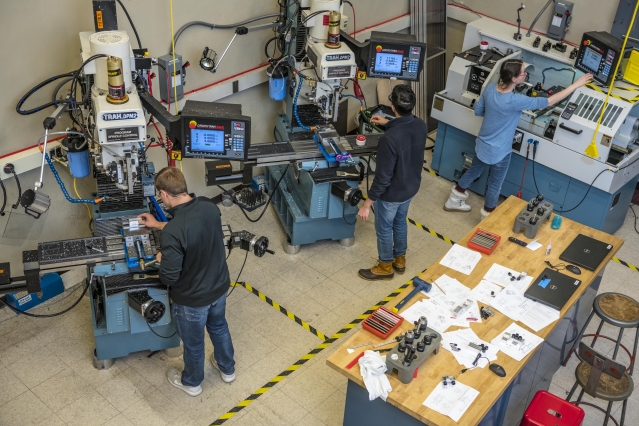
Many of these roles are skilled trades and technical operations—not just engineering—which has pushed Arizona’s community colleges and universities to expand semiconductor training pipelines.

Industrial policy, here, isn’t theoretical. It’s vocational.


Housing Pressure: The Invisible Side Effect

https://www.azcentral.com/gcdn/authoring/authoring-images/2024/10/07/PPHX/75563097007-screenshot-277.png?auto=webp&fit=crop&format=pjpg&height=705&width=863
https://www.azcentral.com/gcdn/presto/2022/12/23/PPHX/abc41c8c-7a97-4bc4-9671-adabae5ce716-20620_North_19th_Aveune_Phoenix_Deer_Valley_2.png?auto=webp&crop=1086%2C611%2Cx33%2Cy16&format=pjpg&height=543&width=1086

As construction accelerated, housing demand followed—engineers, contractors, vendors, and service workers all seeking proximity. Builders responded, but entitlement timelines and infrastructure constraints slowed supply.

The result: upward pressure on prices and rents.

Wired has documented similar patterns near new chip fabs in Texas and Ohio, but the North Valley’s transformation is happening faster.
Reference: https://www.wired.com

For longtime residents, the shift feels compressed—decades of growth packed into a few years.


Infrastructure Is Destiny

https://images.openai.com/static-rsc-3/EnVDLifqGAwbHzqVFoGK_AVSgYvtY2tVWbDXkWrDckJE8ZamF99vhYJKU5L7qBln8XmkEmvyLUqutaMtOytLV8crxZXjfQqU3BSjHOX1Pac?purpose=fullsize&v=1
https://www.cbre.com/resources/fileassets/US-SMPL-174197/46291e66/72aca97e-a4bf-4784-a6bb-fa91e9ff7a43_Photo_1_large.jpg

Factories don’t run on optimism. They require water, power, and redundancy.

Water use has drawn scrutiny, but reporting from Reuters and The Arizona Republic shows TSMC’s Arizona facilities are designed to recycle a majority of the water they consume, relying heavily on reclaimed sources.
References:

  • https://www.reuters.com
  • https://www.azcentral.com

Power upgrades tell a parallel story. Substations and transmission improvements built for the fab unlock capacity for everything around it.

In most cities, infrastructure follows growth. Here, growth arrived all at once.


A Desert, Rewired

The North Valley has always been a place of becoming—a region shaped by long horizons and calculated risk. The expansion of TSMC doesn’t change that. It accelerates it.

What’s rising north of Phoenix isn’t just steel and clean rooms. It’s a new role in the global economy, anchored in a place once considered peripheral.

The desert hasn’t disappeared.
It’s been rewired.

And for those who live here, the question isn’t whether change is coming—it’s how intentionally it’s met, and who gets to help shape what comes next.


Leave a Comment

IMMINENT THREAT: Tropical Storm Warning Issued for The Western half of Arizona for the Weekend of August 16th, 2023

Leave a Comment

Are We in A Housing Bubble in 2022?

3 Graphs To Show This Isn’t a Housing Bubble

With all the headlines and buzz in the media, some consumers believe the market is in a housing bubble. As the housing market shifts, you may be wondering what’ll happen next. It’s only natural for concerns to creep in that it could be a repeat of what took place in 2008. The good news is, there’s concrete data to show why this is nothing like the last time.

There’s a Shortage of Homes on the Market Today, Not a Surplus

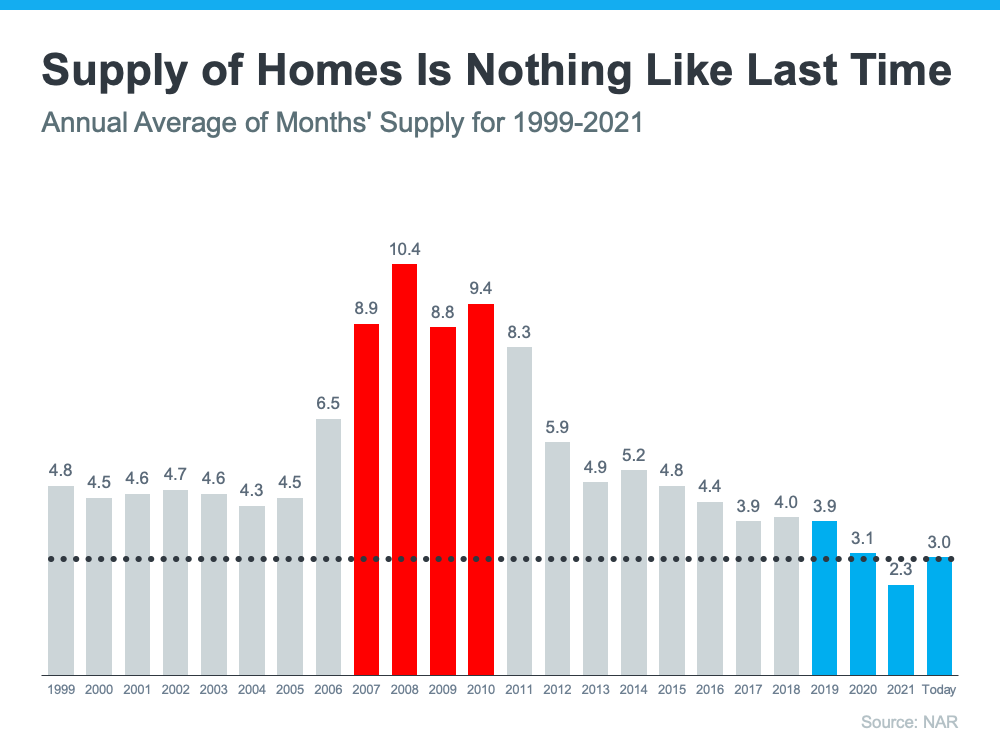
The supply of inventory needed to sustain a normal real estate market is approximately six months. Anything more than that is an overabundance and will causes prices to depreciate. Anything less than that is a shortage and will lead to continued price appreciation.

For historical context, there were too many homes for sale during the housing crisis (many of which were short sales and foreclosures), and that caused prices to tumble. Today, supply is growing, but there’s still a shortage of inventory available.

The graph below uses data from the National Association of Realtors (NAR) to show how this time compares to the crash. Today, unsold inventory sits at just a 3.0-months’ supply at the current sales pace.

3 Graphs To Show This Isn’t a Housing Bubble | MyKCM

One of the reasons inventory is still low is because of sustained underbuilding. When you couple that with ongoing buyer demand as millennials age into their peak homebuying years, it continues to put upward pressure on home prices. That limited supply compared to buyer demand is why experts forecast home prices won’t fall this time.

Mortgage Standards Were Much More Relaxed During the Crash

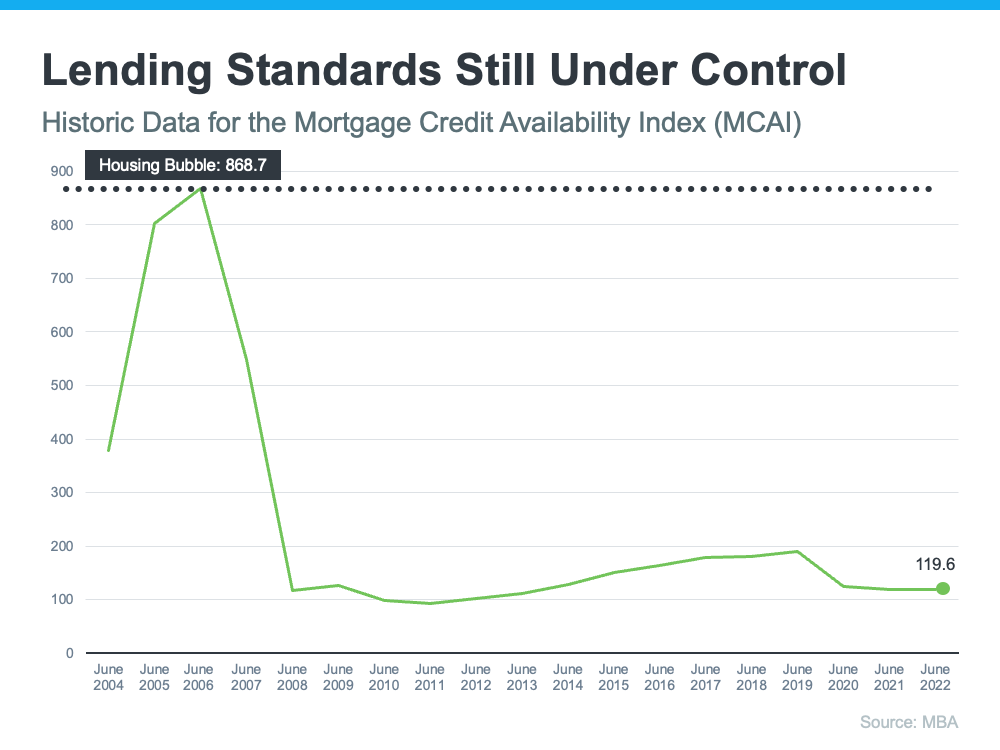
During the lead-up to the housing crisis, it was much easier to get a home loan than it is today. The graph below showcases data on the Mortgage Credit Availability Index (MCAI) from the Mortgage Bankers Association (MBA). The higher the number, the easier it is to get a mortgage.

3 Graphs To Show This Isn’t a Housing Bubble | MyKCM

Running up to 2006, banks were creating artificial demand by lowering lending standards and making it easy for just about anyone to qualify for a home loan or refinance their current home. Back then, lending institutions took on much greater risk in both the person and the mortgage products offered. That led to mass defaults, foreclosures, and falling prices.

Today, things are different, and purchasers face much higher standards from mortgage companies. Mark Fleming, Chief Economist at First American, says:

“Credit standards tightened in recent months due to increasing economic uncertainty and monetary policy tightening.” 

Stricter standards, like there are today, help prevent a risk of a rash of foreclosures like there was last time.

The Foreclosure Volume Is Nothing Like It Was During the Crash

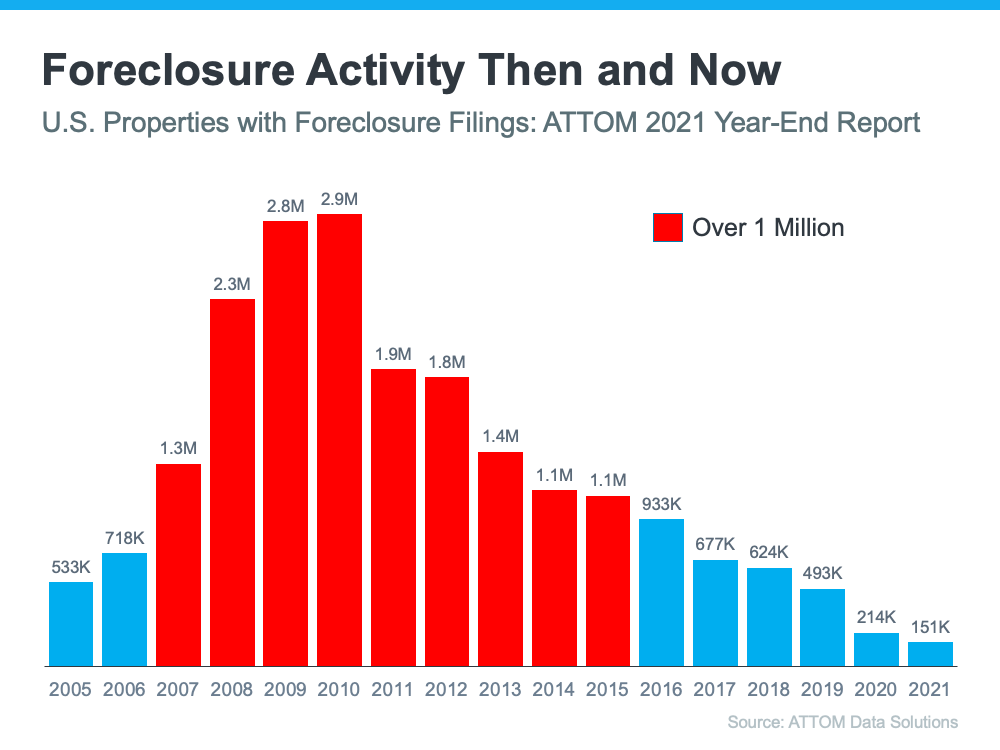
The most obvious difference is the number of homeowners that were facing foreclosure after the housing bubble burst. Foreclosure activity has been on the way down since the crash because buyers today are more qualified and less likely to default on their loans. The graph below uses data from ATTOM Data Solutions to help tell the story:

3 Graphs To Show This Isn’t a Housing Bubble | MyKCM

In addition, homeowners today are equity rich, not tapped out. In the run-up to the housing bubble, some homeowners were using their homes as personal ATMs. Many immediately withdrew their equity once it built up. When home values began to fall, some homeowners found themselves in a negative equity situation where the amount they owed on their mortgage was greater than the value of their home. Some of those households decided to walk away from their homes, and that led to a wave of distressed property listings (foreclosures and short sales), which sold at considerable discounts that lowered the value of other homes in the area.

Today, prices have risen nicely over the last few years, and that’s given homeowners an equity boost. According to Black Knight:

“In total, mortgage holders gained $2.8 trillion in tappable equity over the past 12 months – a 34% increase that equates to more than $207,000 in equity available per borrower. . . .”

With the average home equity now standing at $207,000, homeowners are in a completely different position this time.

Bottom Line

If you’re worried we’re making the same mistakes that led to the housing crash, the graphs above should help alleviate your concerns. Concrete data and expert insights clearly show why this is nothing like the last time.

Looking for a new home?

If you’re interested in purchasing or selling a home you can start by Contacting Us directly or start searching for your new home here Anthem, Desert Hills, New River, Phoenix, Mesa, Scottsdale, Tempe, Glendale or Surprise.

Also, check out our mini-series North Valley Spotlight

Tagged With: Market InformationLeave a Comment

Key Factors That Impact Affordability in 2022

Key Factors That Impact Affordability Today

Key Factors That Impact Affordability Today | MyKCM

You can’t read an article about residential real estate without the author mentioning the affordability challenges that today’s buyers face. There’s no doubt homes are less affordable today than they were over the last two years, but that doesn’t mean homes are now unaffordable.

There are three measures used to establish home affordability: home prices, mortgage rates, and wages. Let’s look closely at each of these components.

1. Home Prices

The most recent Home Price Insights report by CoreLogic shows home values have increased by 19.1% from last January to this January. That was one reason affordability declined over the past year.

2. Mortgage Rates

While the current global uncertainty makes it difficult to project mortgage rates, we do know current rates are almost one full percentage point higher than they were last year. According to Freddie Mac, the average monthly rate for last February was 2.81%. This February it was 3.76%. That increase in the mortgage rate also contributes to homes being less affordable than they were last year.

3. Wages

The one big, positive component in the affordability equation is an increase in American wages. In a recent article by RealtyTrac, Peter Miller addresses that point:

“Prices are up, but what about wages? ADP reports that job holder incomes increased 5.9% last year but rose 8.0% for those who switched employers. In effect, some of the higher cost to buy a home has been offset by more cash income.”

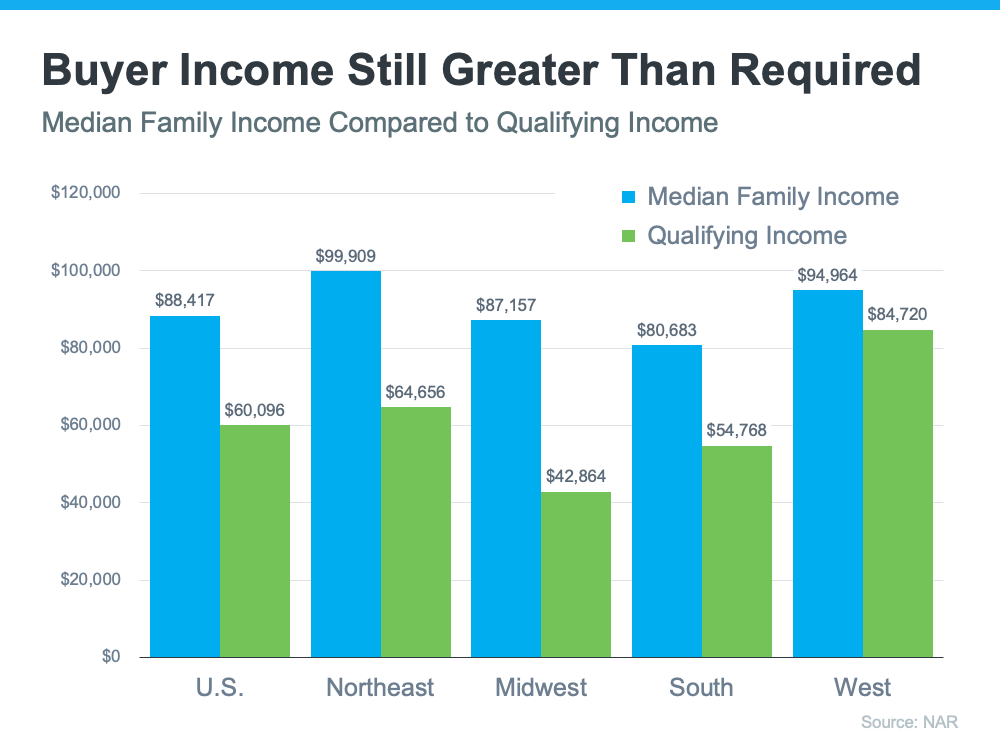
The National Association of Realtors (NAR) also recently released information that looks at income and affordability. The NAR data provides a comparison of the current median family income versus the qualifying income for a median-priced home in each region of the country. Here’s a graph of their findings:

Key Factors That Impact Affordability Today | MyKCM

As the graph shows, the median family income (shown in blue on the graph) is greater than the qualifying income needed to buy a median-priced home (shown in green on the graph) in all four regions of the country. While those figures may vary in certain locations within each region, it’s important to note that, in most of the country, homes are still affordable.

So, when you think about affordability, remember that the picture includes more than just home prices and mortgage rates. When prices rise and rates rise, it does impact affordability, and experts project both of those things will climb in the months ahead. That’s why it’s less affordable to buy a home than it was over the past two years when prices and rates were lower than they are today. But wages need to be factored into affordability as well. Because wages have been rising, they’re a big reason that, while less affordable, homes are not unaffordable today.

Bottom Line

To find out more about affordability in our local area, let’s discuss where home prices are locally, what’s happening with mortgage rates, and get you in contact with a lender so you can make an informed financial decision. Remember, while less affordable, homes are not unaffordable, which still gives you an opportunity to buy today.

Looking for a new home?

If you’re interested in purchasing or selling a home you can start by Contacting Us directly or start searching for your new home here Anthem, Desert Hills, New River, Phoenix, Mesa, Scottsdale, Tempe, Glendale or Surprise.

Also, check out our mini-series North Valley Spotlight

Tagged With: Buying a HomeLeave a Comment

Your Journey to Homeownership in 2021

Your Journey to Homeownership [INFOGRAPHIC]

Your Journey to Homeownership [INFOGRAPHIC] | MyKCM

Some Highlights

  • When it comes to buying a home, there are a number of key milestones along the way.
  • The process includes everything from building your team and understanding your finances to going house hunting, making an offer, and more.
  • When you’re ready to start your journey, let’s connect so you have trusted guidance at every milestone in the process.

Looking for a new home?

If you’re interested in purchasing or selling a home you can start by Contacting Us directly or start searching for your new home here Anthem, Desert Hills, New River, Phoenix, Mesa, Scottsdale, Tempe, Glendale or Surprise.

Also, check out our mini-series North Valley Spotlight

Tagged With: Buying a HomeLeave a Comment

Don’t Wait for a Lower Mortgage Rate – It Could Cost You

Don’t Wait for a Lower Mortgage Rate – It Could Cost You

Don’t Wait for a Lower Mortgage Rate – It Could Cost You | MyKCM

Today’s housing market is truly one for the record books. Over the past year, we’ve seen the lowest mortgage rates in history. And while those rates seemed to bottom out in January of this year, the golden window of opportunity for buyers isn’t over just yet. If you’re one of the buyers who worry they’ve missed out, rest assured today’s mortgage rates are still worth taking advantage of.

Even today, our mortgage rates are below what they’ve been in recent decades. So, while you may not be able to lock in the rate your friend got recently, you’re still in a great position to secure a rate well below what your parents and even grandparents got in years past. The key will be acting sooner rather than later.

Don’t Wait for a Lower Mortgage Rate – It Could Cost You | MyKCM

In late September, mortgage rates ticked above 3% for the first time in months. And according to experts throughout the industry, mortgage rates are projected to continue rising in the months ahead. Here’s where experts say rates are headed:While a projected half percentage point increase may not seem substantial, it does have an impact when you’re buying a home. When rates rise even slightly, it affects how much you’ll pay month-to-month on your home loan. The chart below shows how it works:In this example, if rates rise to 3.55%, you’ll pay an extra $100 each month on your monthly mortgage payment if you purchase a home around this time next year. That extra money can really add up over the life of a 15 or 30-year loan.

Clearly, today’s mortgage rates are worth taking advantage of before they climb further. The rates we’re seeing right now give you a unique opportunity to afford more home for your money while keeping your monthly payment down.

Bottom Line

Waiting for a lower mortgage rate could cost you. Experts project rates will continue to rise in the months ahead. Let’s connect so you can seize this opportunity before they increase further.

Looking for a new home?

If you’re interested in purchasing or selling a home you can start by Contacting Us directly or start searching for your new home here Anthem, Desert Hills, New River, Phoenix, Mesa, Scottsdale, Tempe, Glendale or Surprise.

Also, check out our mini-series North Valley Spotlight

Leave a Comment

  • 1
  • 2
  • 3
  • Next Page »

Anthem Homes and Lifestyle

Anthem Homes and Lifestyle

Patterson Real Estate Group

Patterson Real Estate Group

Facebook – Other Pages to Follow

Anthem Community Facebook Page

Living North Valley Facebook Page

Explore Subjects

Recent Posts

  • AARP Free Tax Aide
  • ACC Finance Committee Meeting
  • Anthem’s Market in the Park
  • Sonoran Charity Concours Show
  • ACCCA Lifestyle Enhancement Committee Meeting

Archives

© 2026 AllAboutAnthem.com 2012 - 2025